

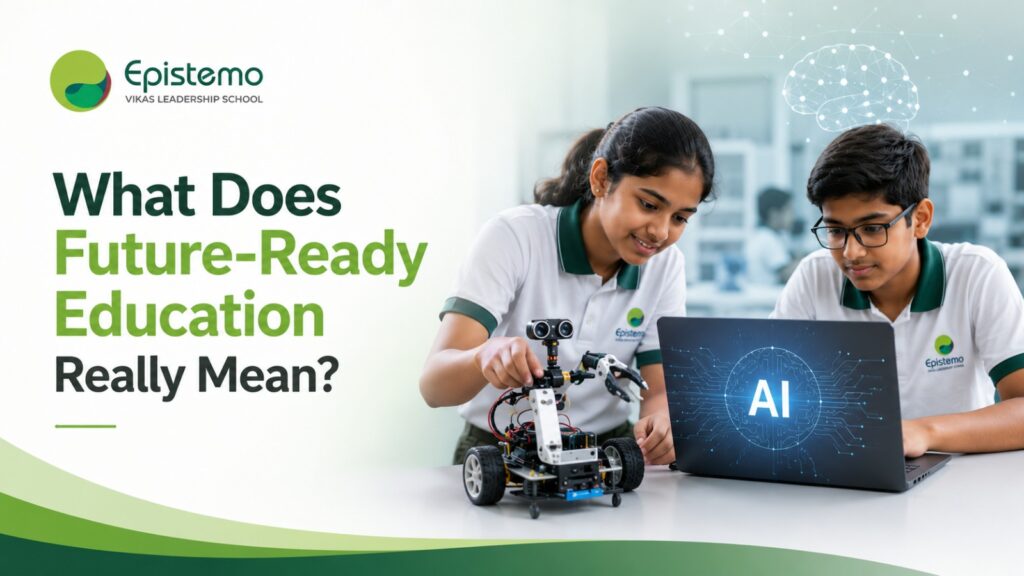
"Future-ready" has become a common phrase in education today. To truly understand it, we focus on core values like adaptability and human skills, which keep readers engaged and aligned with the school's philosophy.
More Than Technology
The misconception is that future-ready means more screens and gadgets. While digital fluency is essential, true readiness involves developing skills that technology cannot replace, like creativity and empathy.
True future-readiness is about the human capabilities that technology cannot replace. As machines take over routine and repetitive work, the skills that will distinguish people are precisely the ones that are hardest to automate: creativity, critical thinking, empathy, and sound judgment. A future-ready education develops the child, not just the child's tools.
The Ability to Keep Learning
This is why future-ready education emphasizes learning how to learn, fostering curiosity and confidence so students can adapt to industries that may not yet exist.
This is why future-ready education prioritises learning how to learn. We want naturally curious students, comfortable with the unfamiliar, and confident that they can master something new whenever they need to. A child who loves learning will never be left behind because they can always adapt.
Thinking, Not Just Knowing
For a long time, education rewarded memorisation. Today, information is everywhere and instantly available; what is scarce is the ability to think well about it. Can a student tell a reliable source from a misleading one? Can they reason through a problem, weigh evidence, and form an independent view?
Future-ready education shifts the emphasis from knowing the right answer to asking the right questions. It values reasoning, analysis, and the courage to think for oneself — skills that serve a young person in every subject, every career, and every decision of adult life.
Creativity and Problem-Solving
The challenges the coming generation will face, from climate change to technologies we cannot yet imagine, will not be solved by following old templates. They will demand fresh thinking. Future-ready students are encouraged to experiment, to imagine alternatives, and to see problems as opportunities for invention.
This creative confidence is nurtured not only in art and music, but across the curriculum: in designing a science experiment, in finding an unexpected approach to a maths problem, in building something that has never been built before.
People Skills for a Connected World
In an increasingly automated economy, human connection becomes more valuable, not less. The ability to communicate clearly, collaborate across differences, lead with integrity, and understand others' perspectives is essential in any workplace and in life itself.
Future-ready education, therefore, treats emotional intelligence and collaboration as core skills that help children feel connected and valued, not just soft extras. Group projects, discussion, teamwork, and real-world engagement all foster a sense of belonging and purpose, which may prove to be the most enduring skill of all.
Grounded in Strong Values
Finally, being ready for the future is not only about capability but also about character. A student equipped with powerful skills but no moral compass is not truly prepared. Future-ready education is rooted in values: honesty, responsibility, resilience, kindness, and respect for others and the planet.
In a fast-changing world, strong values act as an anchor. They help young people use their abilities wisely and make decisions they can be proud of.
Our View at Epistemo School
At Epistome School, Hyderabad, we see future-ready education as a balance between rigorous academics and the human qualities that give knowledge its meaning. We aim to develop adaptable learners, independent thinkers, creative problem-solvers, and compassionate individuals-children who feel confident and hopeful about their ability to shape any future they choose to build.
Because in the end, the goal of a future-ready education is not to predict what is coming. It is to raise young people who are confident, capable, and grounded enough to meet whatever comes and to shape it for the better.